

Photo by Everett Ackley (C ’27)
Chloe Wright
Editor-in-Chief
Perla Guzman Martinez (C ‘27) contributed to this article.
Monday night’s hour-long, campus-wide discussion about Sewanee’s endowment at the Greenhouse was initially polite. Vice-Chancellor Pearigen, Chief Financial Officer Isabelle Puckette Love and Provost Scott Wilson spoke civilly about Sewanee’s investments in aerospace and defense industries with around 50 attendees. The administration addressed the lack of communication about the stock portfolio and promised to follow-through on a sustainability report by the end of the month. However, once the administration left the Greenhouse, there was a buzz of discontent, frustration and disappointment from students, faculty and community members alike.
Some attendees said that Sewanee’s administration is greenwashing and hand-waving, and others felt disappointed in the lack of meaningful change. This has been a decades-long battle for students to have their voices heard by the administration. The debate received nationwide attention when covered by the New York Times in 2020 when the Socially Conscious Investment Club struggled with the administration and former Treasurer Doug Williams.
Greenhouse member Sophie Nolan (C ‘28), who helped manage breakout group discussions at the event, said that “it was a great conversation we had tonight.” But, even though the meeting went well, she said she wants “to see some more communication and transparency with our governing bodies about our investments and also our plans for building this community sustainably.”
In one of these breakout groups, Assistant Politics Professor Sid Simpson said making progress may require pushing beyond Sewanee’s imperative to be nice. “Getting things done at Sewanee is most effective when you embarrass the administration or confront them or the Board of Regents head-on. Rowland (Fournier (C ‘27), one of the event’s presenters) was kind in not bringing up that we were nationally embarrassed by our response to the first socially conscious investment group,” Simpson said.
“It’s in these instances that it becomes clear that going through the usual paths that the administration has doesn’t actually get us where we need to.” He participated in an advisory committee which guided the Investment Management Committee in Easter semester 2025 on how to realign the investments with Episcopal principles and the investment principle of Environmental, Social and Governance.
Love, the University’s treasurer, said the reason behind the administration’s slow progress is because Sewanee is driven by general agreement. “One benefit of Sewanee is we make decisions slowly because we gain a lot of consensus and hear a lot of different perspectives and we take that all in and decide what our next step is.”
Simpson disagreed with Love, saying that the IMC did not give background information about their investment policies or speak to the ESG committee directly. “It did feel like we were talking to a blank wall. It did not feel like anything that resembled consensus to us. It’s unclear to me what consensus would mean when the IMC is not even willing to have conversations or even identify who is on the IMC.”
Fournier was one of two College of Arts and Science students on the advisory committee. At Monday night’s discussion event, he said he wished the Greenhouse had more time and that Love, Pearigen and Wilson told them they had to leave the event at 8:30. “It’s difficult to get long-term, meaningful discussions when it’s also difficult to schedule. I wish those things were canceled and that more effort was made to be present.”
He said the goal of the event was to inform the student body, who might not understand the financial terms relevant to the discussion or have read the New York Times article. “This is a first step of information and dialogue towards more and more meaningful action…We’ve been waiting for seven years, and I’m not too interested in waiting any longer.”
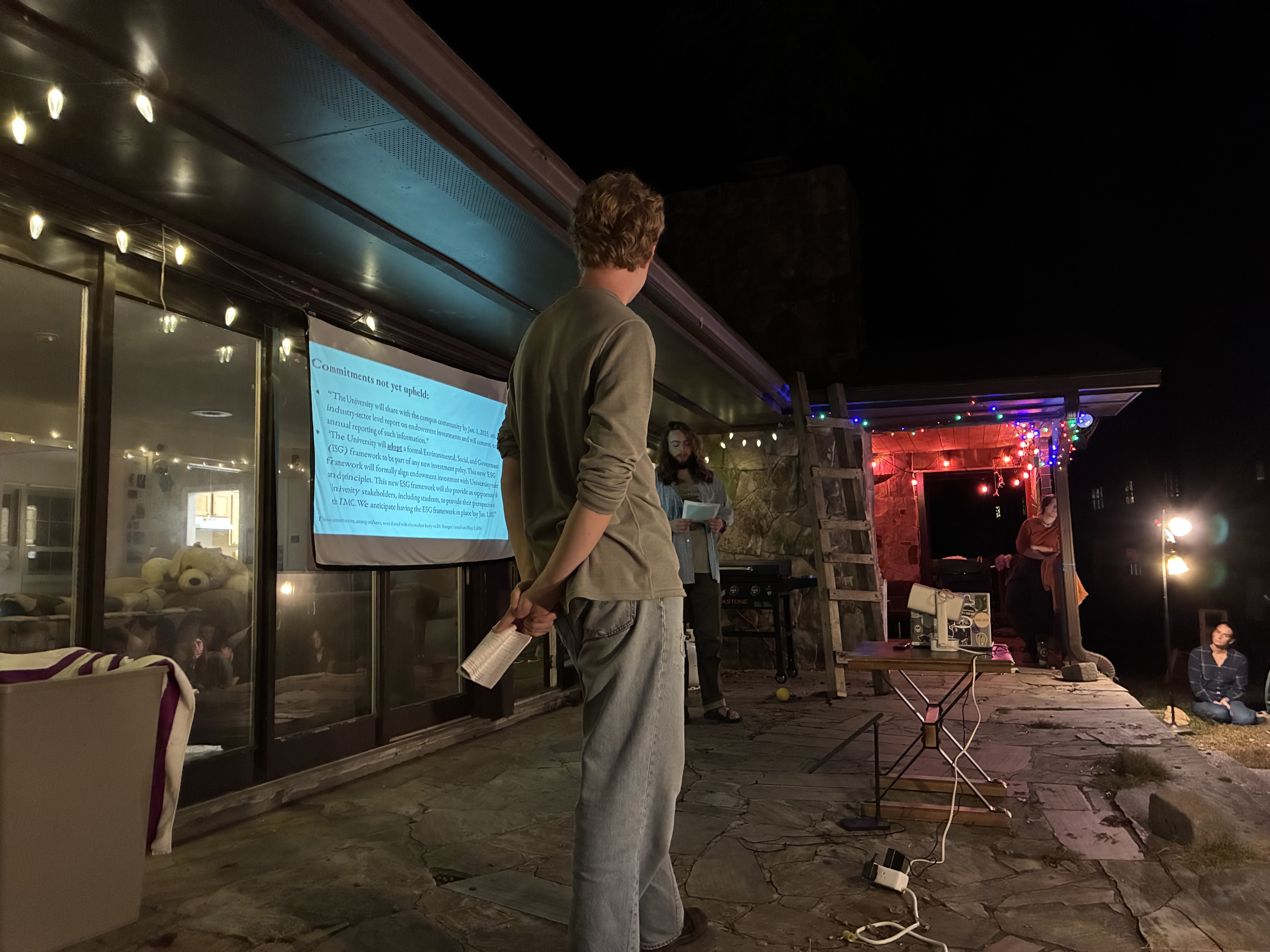
Fournier and Greenhouse member Xan Mihalas (C ‘27) reviewed Sewanee’s investments in the Episcopal church’s no-buy list profile restrictions and criticized the University’s lack of follow-through with commitments given after the May 2024 Sewanee for Palestine protest.
Fournier said that Sewanee has invested around $3.3 million dollars in companies that fall under the no-buy list. While he does not know the identities of the University’s stock holdings, he listed possible companies like Caterpillar Inc., ExxonMobil and various for-profit prisons. “Our investments go toward companies. They are bought shares of companies, and that money goes toward the company’s actions,” Fournier said. “Therefore, when we invest in these companies, we are also financially supporting the actions of these companies.”
Mihalas argued that the industry-sector and annual reports of endowment did not happen, and an ESG policy to Sewanee’s investments also was not adopted by Jan. 1, 2025, the deadline Pearigen set in his May 4, 2024 email to the student body. Though that was not a hard deadline, Mihalas and Fournier noted that it has now been more than a year and a half without action.
At the end of their presentation, Fournier and Mihalas called for divestment. In response, Provost Wilson discussed how the ESG working group that he chaired decided that they “were going to work on a set of principles rather than a hard exclusionary policy.” That working group included Fournier as the representative from the Order of the Gown.
The Board of Regents and the working group drafted a University Sustainability Statement. Wilson said this statement included “a dashboard that would detail parts of the endowment and how we are doing with regard to improvement on the endowment.” The working group also developed the Advisory Report and Responsible Investment statement, draft copies and summaries of which were distributed during the event.
Wilson said he would provide a report at the end of this month that will include the endowment dashboard, and the University Sustainability Committee will also propose investments in sustainable campus infrastructure. “I think those are important, concrete steps that we’re on the cusp of taking,” he said, “and I think those will make us a better institution.”
Another goal of the working group was to establish a University Sustainability Committee, which Wilson chairs.
However, the Board of Regents’ IMC, which is the only group which knows the identities of the University’s stock holdings, rejected the working group’s finalized report. Ever since, Wilson said, the ESG working group has tried to “push [the IMC] further on some sort of response in terms of providing information to the stakeholders on campus.”
Love introduced herself by listing environmentally conscious factoids about herself. “I have been a vegetarian since I was five years old,” she told the gathering. ”I have a steel drum in my backyard to compost, and I try to reduce single use plastics as much as possible.”
She talked about how the University purchases stocks through indices, which allow investment in a wide array of companies for relatively low fees and low risk. But buying such large aggregations of securities means “you’re going to catch companies like Walmart, potentially, or ExxonMobil,” she said. Having stocks in companies that fall into the Episcopal no-buy list is not a conscious choice by the University, she added, but is a consequence of trying “to get market exposure for less fees and limit our risk by not putting all our eggs in one basket.”
“I think all of the sustainability initiatives that we are pushing forward on this campus have, frankly, more of an impact over a longer time horizon,” she said. “We continue, as Scott said, to work with the Investment Committee and to discuss these questions of transparency and socially responsible investing.”
In his response to the students’ presentations, Pearigen acknowledged the lack of follow-up in regard to the May 2024 commitments. “When I look at those statements we made, I realize that we have not done as good a job as we could and should, in terms of reporting. That’s a fact,” he said. “I will be working with Scott and Isabelle and our IMC on what that looks like.”
He agreed with Love about the role of indices in University investments. “The [IMC] actually [has] responsibility for our endowment. We can’t just go in there and say, ‘Okay, do this and do that.’ As Isabelle said so well, it’s part of an index fund that you can’t just pull out pieces.”
To move forward, he said that IMC members who are part of the oil and gas industries are interested in giving presentations to students and sharing their perspectives. The 26-member Board of Regents includes the Chief Financial Officer of Mewbourne Oil, one of the largest privately held oil production companies in the U.S. The head of the board’s investment committee is Executive Director of a Houston, Texas, nonprofit foundation partnering with a number of universities on promoting research, innovation and entrepreneurship in energy sector transition.
“We can make that happen, and I think it would be helpful for all of us to hear from them and from them to hear from you as well.”